CaveBench: Benchmarking Abductive Physical Reasoning
from Internal Observations

Guanxin Lin1,*, Chen Yang1,*, Shenxiang Zeng1, Honghui Zhu1, Xin Li1, Wenbo Deng1, Jiansheng Fan1, Chen Wang1,†

1Tsinghua University * Equal contribution† Corresponding author

Given only the view from inside a physical apparatus, can a model reconstruct the external controls that produced each change?

Benchmark design

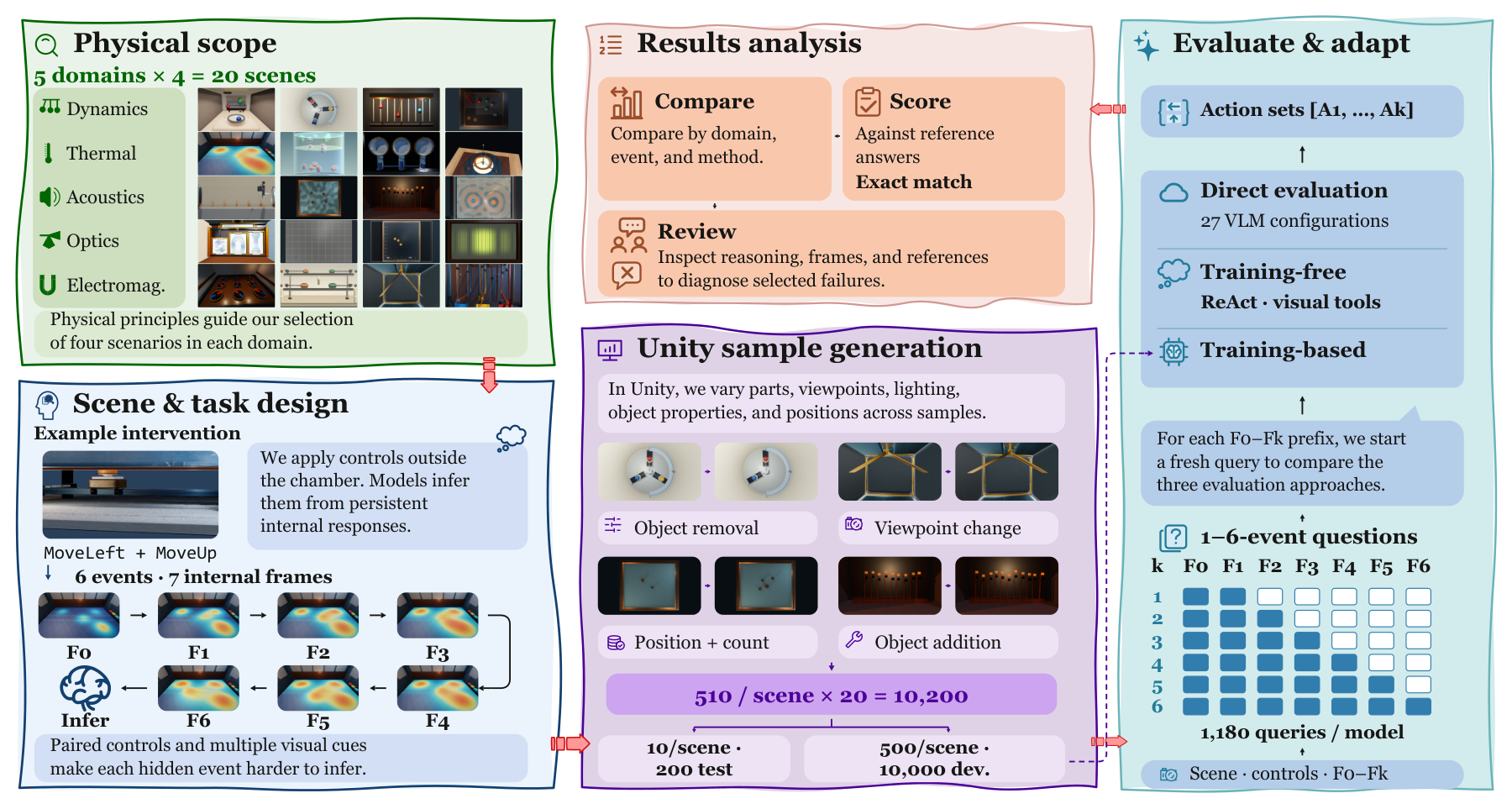
The controls are outside the camera’s view. A model sees an initial image and a new observation after each event. From changes that accumulate inside the apparatus, it must recover which controls were applied together and in what order.

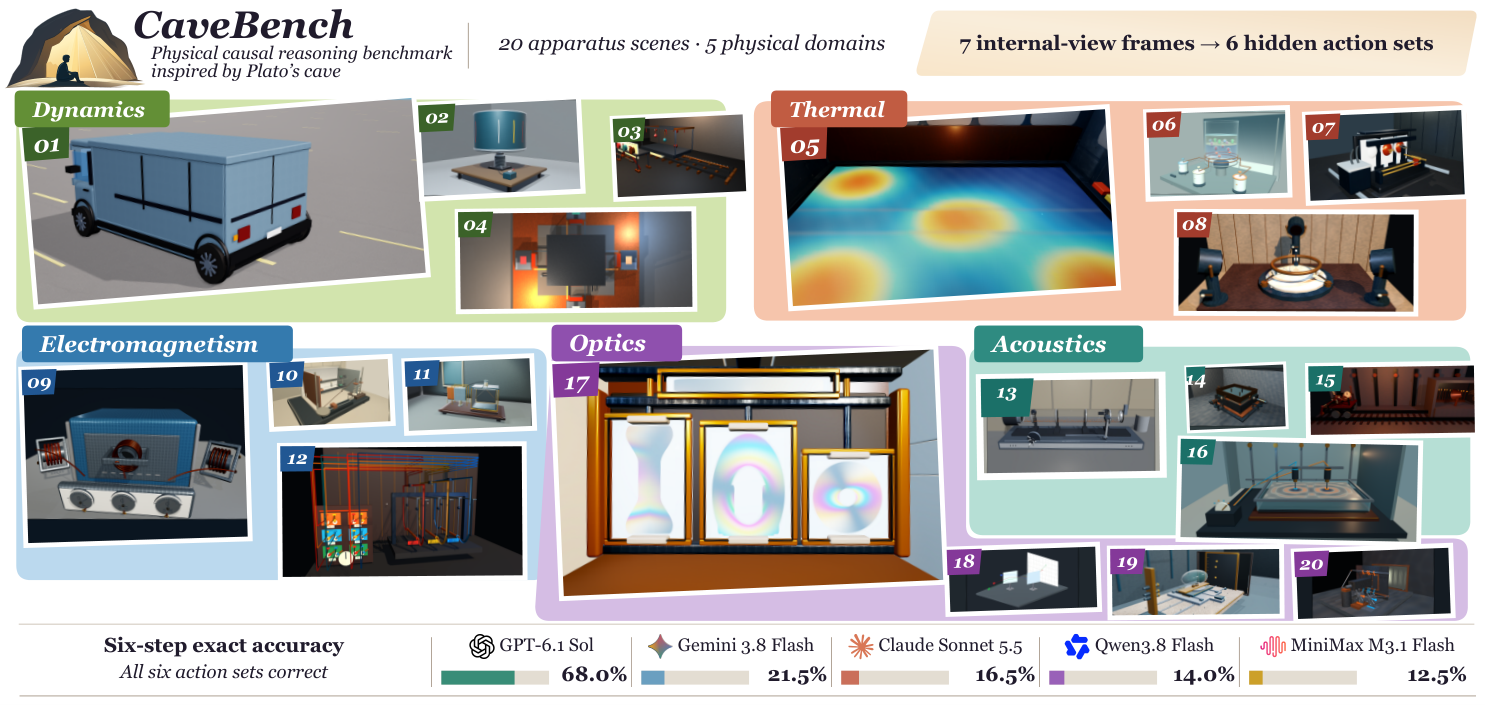
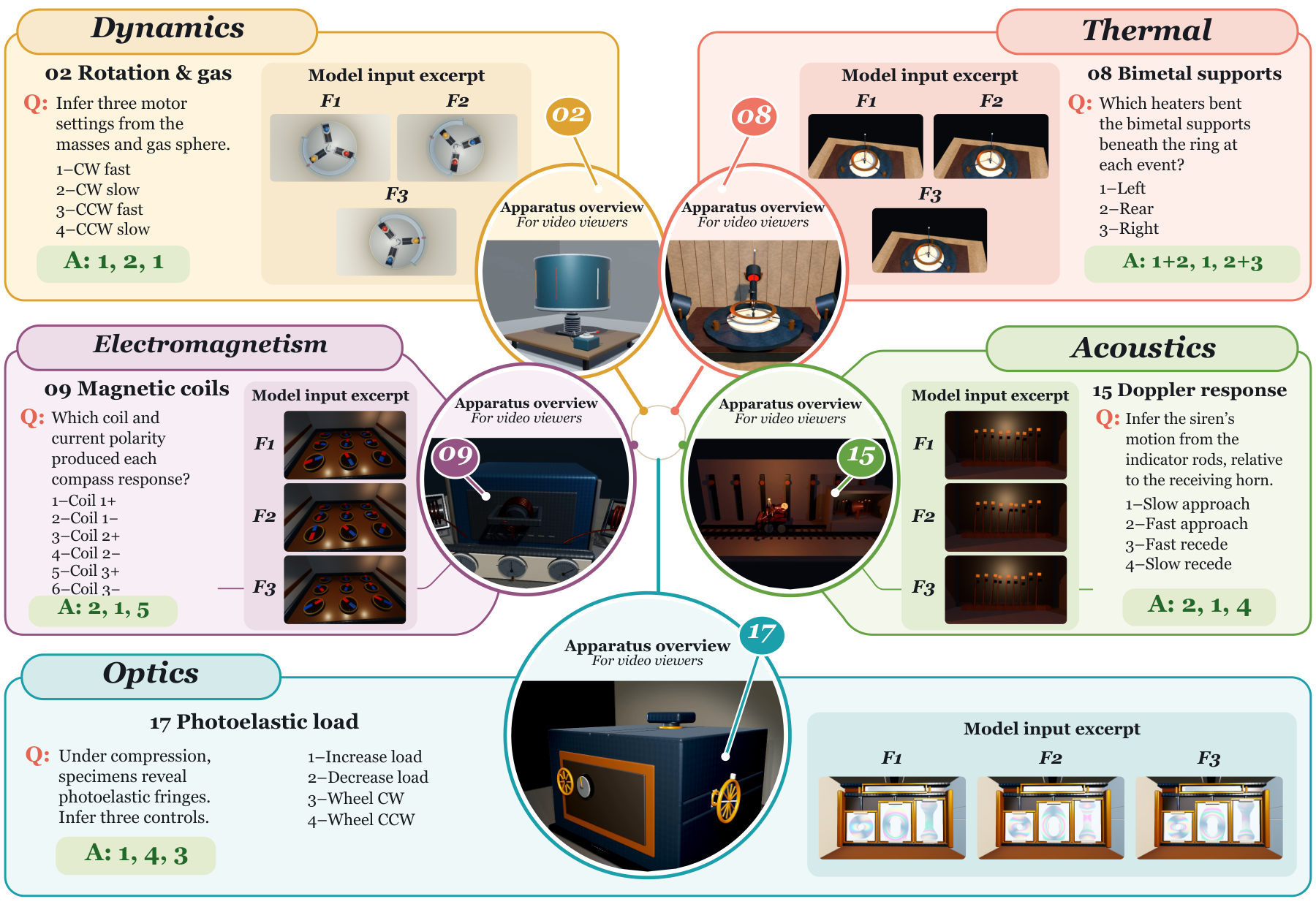
Examples from the five physical domains, with interior views, apparatus illustrations and six-event scores.
Read the paper abstract

Vision-language models (VLMs) are advancing in physical reasoning, but whether they can understand external physical drivers from internal observations remains an open question. Existing benchmarks have not specifically targeted this setting. To this end, we introduce CaveBench, a benchmark for abductive physical reasoning from internal observations. Models receive apparatus descriptions and internal images while the external controls remain hidden, and must infer the operations responsible for the observed responses. CaveBench spans 20 apparatus scenes in five physical domains and contains 10,200 simulated episodes, split into 9,000 training, 1,000 validation, and 200 test episodes. Questions span one to six events and require the complete control set at every event, testing whether an explanation accounts for the entire process. Synchronized observations and control records provide the inputs and reference answers. Evaluating 27 VLM configurations yields six-event exact-match accuracies of 68.0% for the strongest closed-source model and 12.5% for the strongest open-weight model. Seven adaptation baselines show that single-event gains need not improve complete sequences. Error analysis identifies failures in visual identification, physical inference, evidence integration, and action composition, specifying where current models struggle to connect internal phenomena with their external causes.

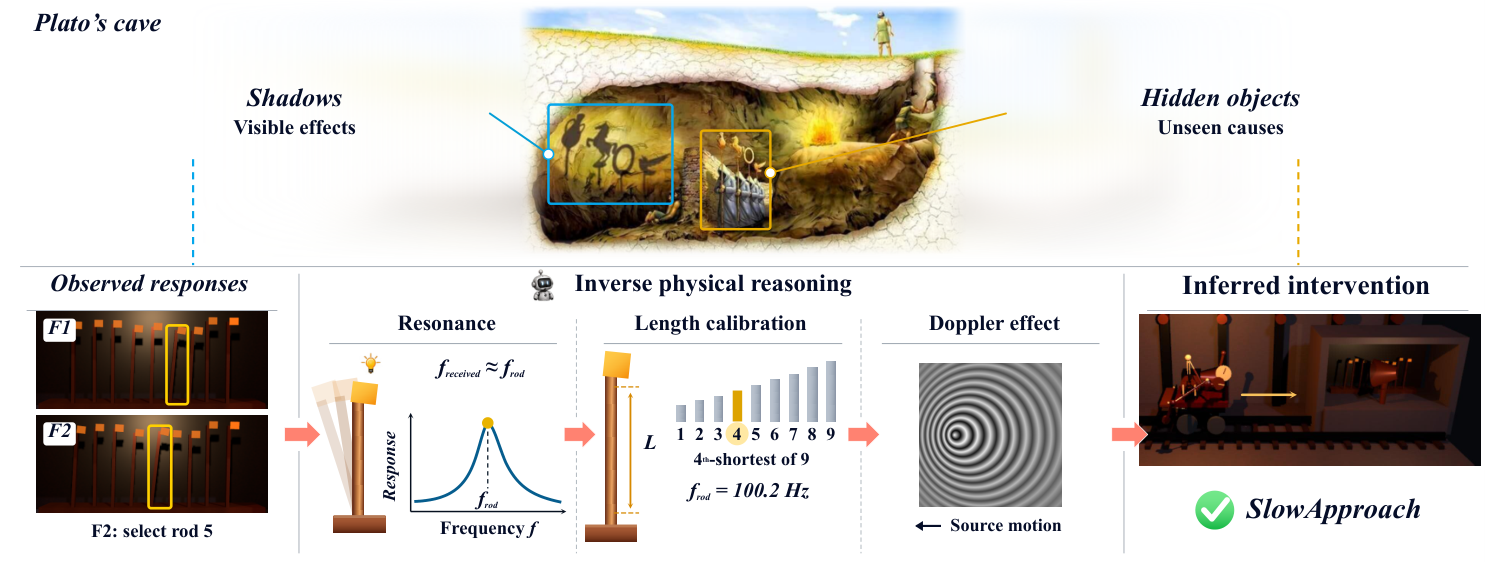
What can a vibrating rod reveal?

Each rod responds most strongly to a different frequency. When a different rod begins to vibrate, its calibrated frequency and the Doppler effect help the observer infer how the unseen sound source moved.

Resonant rods, the hidden sound source, and the interior observations used to infer its motion.

Dataset

Twenty apparatuses span five physical domains. Their 200 test episodes yield 1,180 questions, ranging from a single event to a sequence of six.

From episodes to questions

Each simulated episode pairs an external control log with a sequence of internal images. The release contains 9,000 training episodes, 1,000 validation episodes and 200 test episodes. Each test question ends at a recorded event and asks for every control up to that point.

Pipeline from simulated episodes and synchronized control logs to internal image sequences and scored questions.
Test questions by physical domain
DomainApparatusesEpisodesQuestionsSingle-label eventsTwo-label events
DynamicsS01–S0440240140100
Thermal physicsS05–S084024068172
ElectromagnetismS09–S124022020337
AcousticsS13–S1640240108132
OpticsS17–S204024017961
TotalS01–S202001,180698502

In the dielectric-response apparatus (S11), the first three events show full insertion, half insertion and withdrawal in varying order. Comparing the three leaf openings lets the viewer identify the middle setting. The ten S11 episodes therefore contribute three- to six-event questions. Each of the other 190 episodes contributes all six question lengths.

Example questions

Each question supplies the apparatus description, the available controls and the internal frames up to the last event in the question. A step can require more than one control.

Examples of internal image sequences, questions and reference controls from different CaveBench apparatuses.

Apparatus gallery

Across five domains, the evidence ranges from a pendulum’s tilt to the spacing of interference fringes. Each apparatus below opens an episode with its internal frames, the recorded controls and a model’s answer.

Download the illustrated cases

Evaluation results

On six-event questions, GPT-6.1 Sol recovers every control in 136 of 200 episodes (68.0%). The strongest open-weight model, MiniMax M3.1 Flash, does so in 25 (12.5%).

Model leaderboard

Events per question

    Sol and Terra reach 80.0% and 85.0% in thermal physics. In electromagnetism they score 57.5% and 37.5%. For MiniMax M3.1 Flash, electromagnetism is its strongest domain at 27.5%.

    Question length

    All 27 model configurations have lower exact-match accuracy on six-event questions than on single-event questions. Compare two models across the six question lengths below.

    Training and preference optimization

    Qwen3.5-9B answers one of 200 six-event questions correctly at baseline and 40 after supervised fine-tuning. With SimPO, six-event accuracy reaches 31.8% across two seeds. On the same electroscope frames, the baseline predicts full insertion at the third event. After SFT and SimPO, the model identifies half insertion from the gap between the leaves.
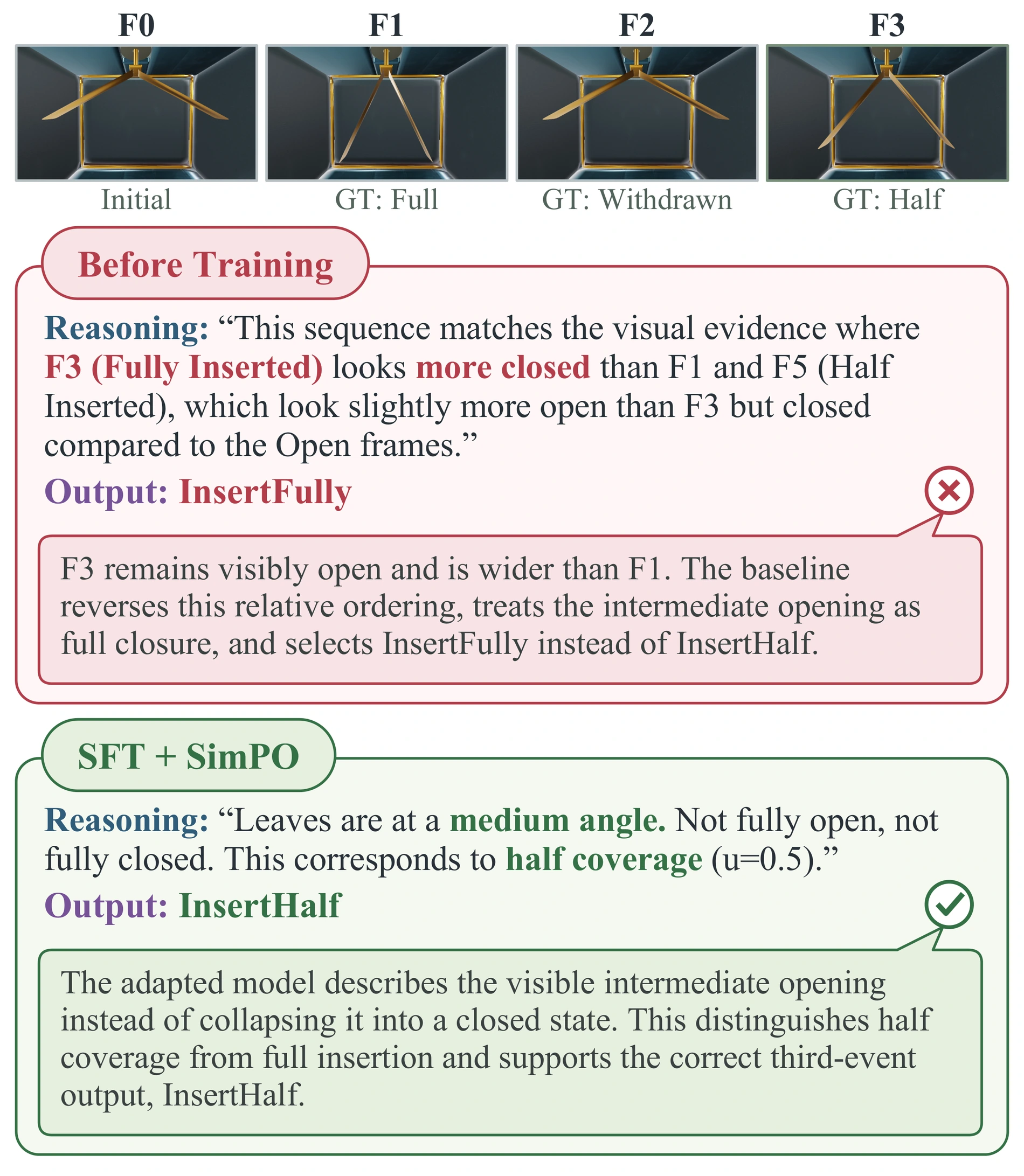
    Comparison of Qwen3.5-9B predictions for the same internal observations, with the paper’s annotations.
    Results for individual training seeds
    Table 12. Qwen3.5-9B sequence exact match (%) across seeds.
    MethodTraining seedk = 1k = 2k = 3k = 4k = 5k = 6Overall
    SFT + SimPO2026110887.472.665.057.032.031.557.2
    SFT + SimPO2026110986.372.666.555.033.032.057.2
    SFT + KTO2026110785.375.867.035.012.514.547.8
    SFT + KTO2026110887.473.769.041.519.014.550.3

    Reasoning effort

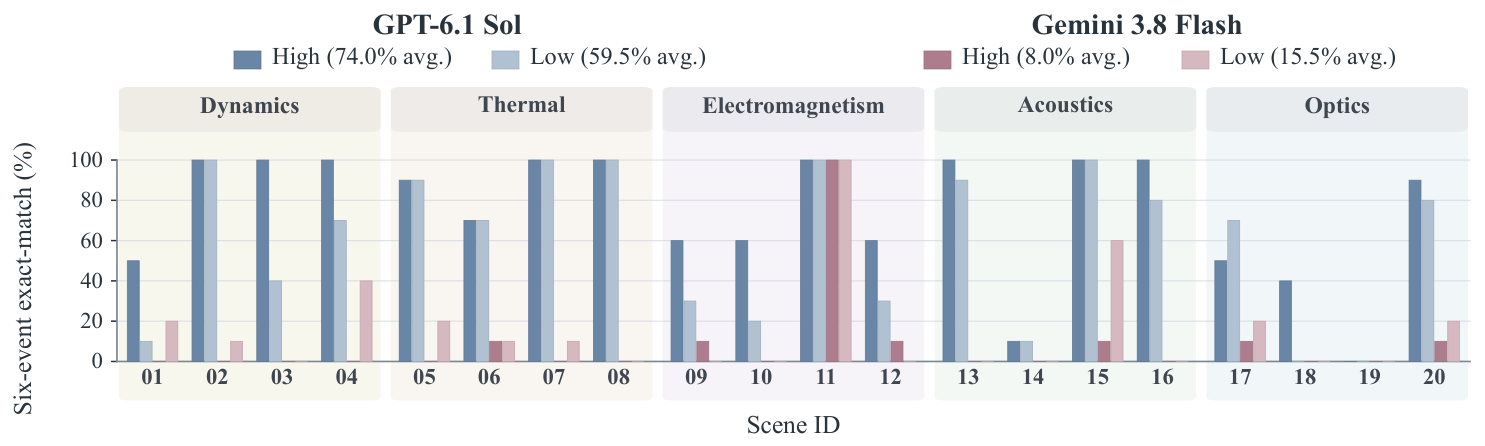
    On the same 200 six-event questions, raising effort from low to high gives GPT-6.1 Sol 29 more correct final answers (59.5% to 74.0%). Gemini 3.8 Flash answers 15 fewer correctly (15.5% to 8.0%).

    Six-event accuracy across reasoning settings for GPT-6.1 Sol and Gemini 3.8 Flash, including apparatus-level results.
    Accuracy and token use at each effort level
    Table 13. Accuracy and mean token use on the 200 six-event questions.
    ModelEffortInitial exact (%)Final exact (%)Final event accuracy (%)Output tokensReasoning tokens
    GPT-6.1 SolLow59.559.582.33520.4471.9
    GPT-6.1 SolMedium67.067.085.921,266.11,217.6
    GPT-6.1 SolHigh73.074.088.423,330.13,287.4
    Gemini 3.8 FlashLow14.015.545.581,841.21,785.9
    Gemini 3.8 FlashMedium20.521.550.675,345.25,279.5
    Gemini 3.8 FlashHigh6.08.038.925,869.85,773.1

    Error analysis

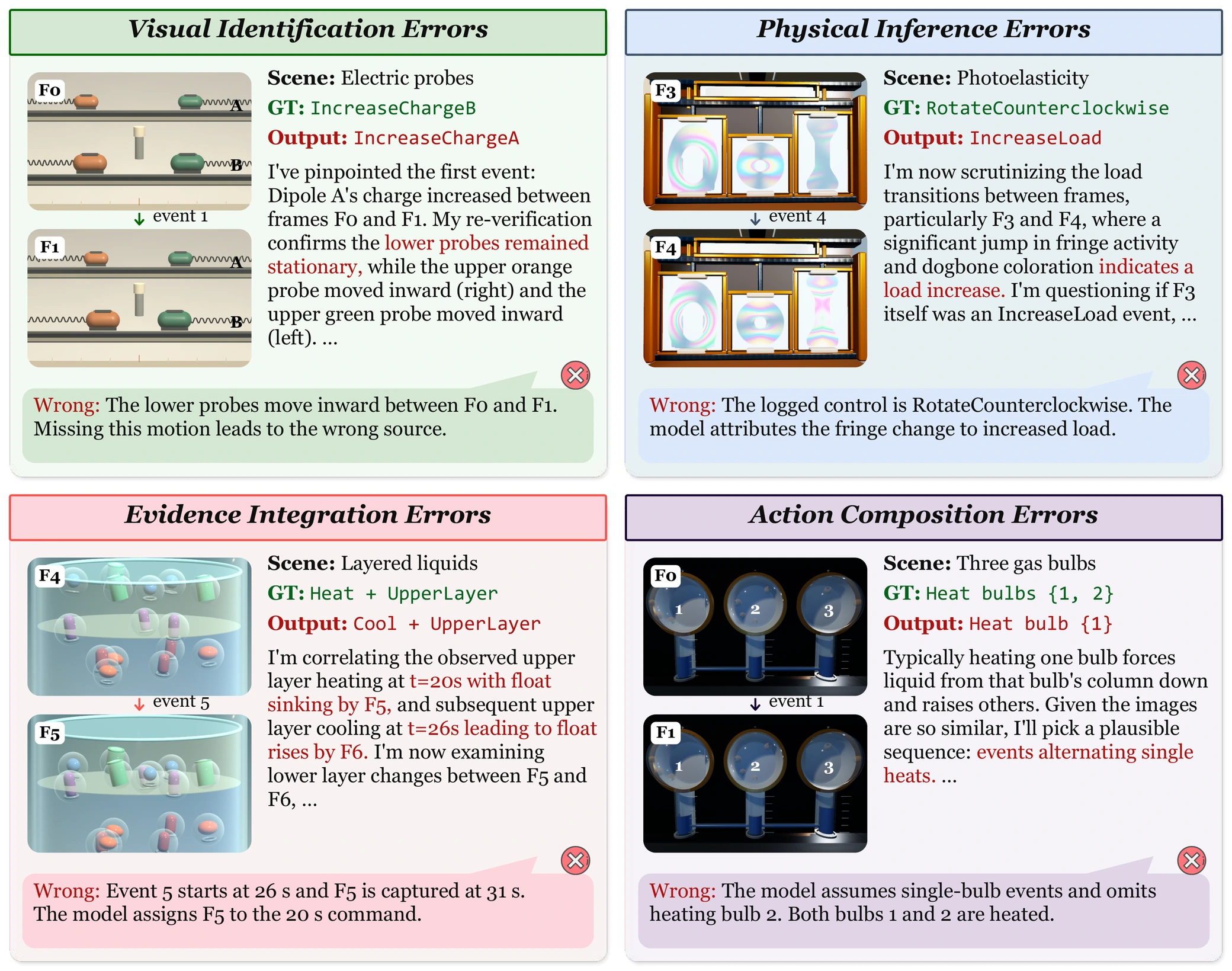
    Among 100 incorrect six-event answers examined in the paper, 38 misread a visual cue, 31 failed to connect observations across time, 24 misapplied a physical principle and seven selected the wrong combination of controls.

    Citation

    @misc{lin2026cavebench,
      title  = {{CaveBench}: Benchmarking Abductive Physical Reasoning from Internal Observations},
      author = {Lin, Guanxin and Yang, Chen and Zeng, Shenxiang and Zhu, Honghui and Li, Xin and Deng, Wenbo and Fan, Jiansheng and Wang, Chen},
      year   = {2026},
      eprint = {2611.32251},
      archivePrefix = {arXiv},
      primaryClass = {cs.CV},
      url    = {https://arxiv.org/abs/2611.32251}
    }